
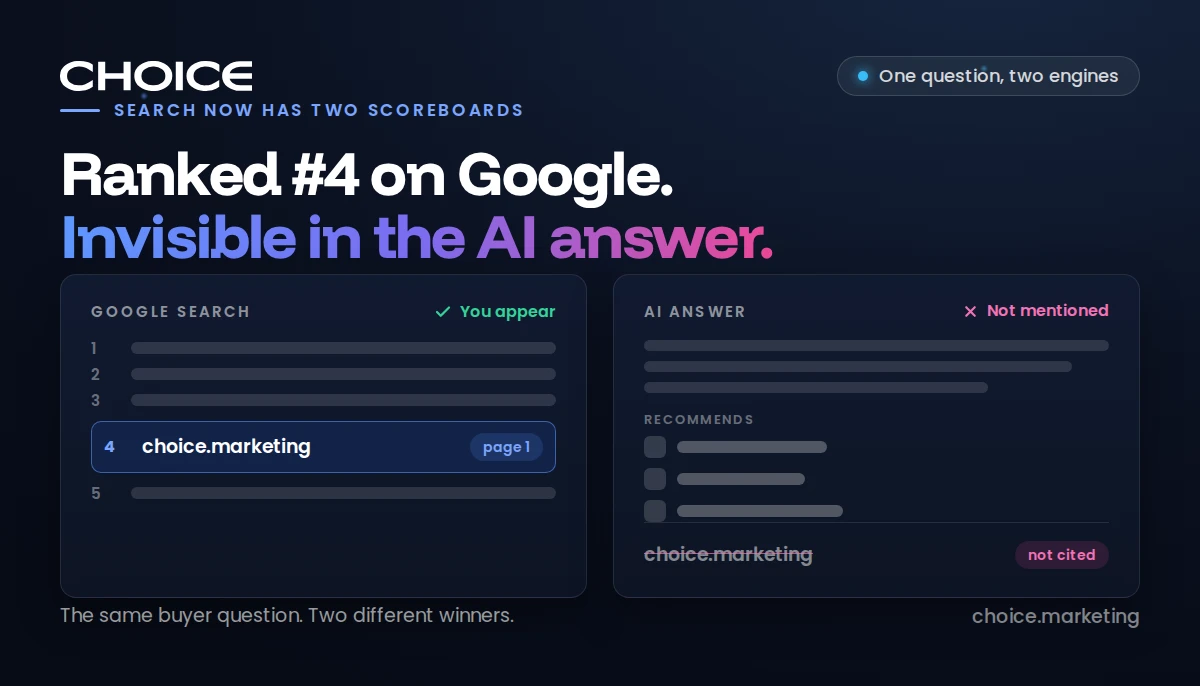
Microsoft's Bing Webmaster Tools now reports two separate scores for a website: a Search Performance report for how well it ranks, and an AI Performance report for how often AI systems cite it as evidence in an answer. Microsoft is explicit that the second report does not measure rankings, authority, or importance; it only shows what got cited. That split makes something visible for the first time: a business can be easy to find in search and still be absent from the evidence AI systems use to build an answer. We track the same buyer questions across Google's classic results, Google's AI answers, and ChatGPT, and below is a question we rank #4 on where no AI answer cites us at all.
Search now has two scoreboards, and most businesses are only watching one. Ranking answers the old question: which page should a human visit? Citation answers the new one: which information can an AI system trust enough to use in its answer? Those are different jobs, they are measured separately, and as of this year the measurement is not agency theory. It is a product feature from the two largest search platforms.
This is the companion to when your customers ask AI who to call, which showed AI reading our clients' sites 85,000 times a month while sending back a trickle of visits. That piece covered where the clicks went. This one covers the scorecard change, and what it looks like when you put the same question to every surface and compare who wins.
Microsoft split the scorecard in February
On February 10, 2026, Microsoft added an AI Performance report to Bing Webmaster Tools, separate from the Search Performance report site owners have used for years. Search Performance still measures the familiar numbers: clicks, impressions, click-through rate, average position. The new AI Performance report measures something else entirely: which pages from your site are cited in AI-generated answers across Microsoft Copilot, Bing's AI summaries, and select partner integrations.
Microsoft's own documentation is blunt about the difference. The AI Performance report does not measure rankings, authority, performance, or importance. It shows which of your content was cited, and nothing more. On June 16, 2026, Microsoft expanded the report with query intents, topics, a Compare view, and a Citation Share metric (more on that one below).
Google did the same thing in the same quarter. On June 3, 2026, Search Console gained a dedicated reporting view for AI Overviews and AI Mode, separate from classic search performance. Two platforms that rarely agree on anything both concluded, within weeks of each other, that AI visibility needed its own report because the old one does not capture it.
That is the whole argument in one product decision. If citation were just a side effect of ranking, neither company would have needed a second report.
The same question, three different winners
We run the test these reports imply, continuously, on our own business. Three times a week, our rank tracker checks the same set of real buyer questions across Google's classic results, Google's AI answers, and ChatGPT search. Here are three of those questions, pulled the first week of July 2026:
| The question a buyer asks | Google organic rank | Google's AI answer | ChatGPT search |
|---|---|---|---|
| "What should I shortlist when choosing an Edmonton marketing firm for PPC, web design, and CRO together?" | #4 | does not cite us | does not cite us |
| "Recommend Edmonton website developers who can rebuild my site and improve lead conversion in the next 90 days." | #5 | does not cite us | cites us as the first source |
| "Which Edmonton digital marketing agency can take over Google Ads and landing pages for a home services business now?" | #14 | cites us as the second source | does not cite us |
Read the rows against each other. The first question is the title of this post: we rank #4 on Google for it, page one, and neither Google's own AI answer nor ChatGPT cites us when asked the identical question. The second flips the pattern: a solid #5 on Google, ChatGPT's top citation, and nothing from Google's AI. The third inverts it again: a mediocre #14 in classic results, yet Google's AI answer cites us second, while ChatGPT ignores us.
We also put the third question to Perplexity on July 5. Its answer recommended three other local agencies by name and never mentioned us in the body, even though our site was one of the ten sources it retrieved to build the answer. That is the distinction in its sharpest form: we were in the evidence pool, and we still were not the evidence. An AI system read our page and chose someone else's passage.
Positions inside AI answers move around week to week, so treat the citation itself as the signal, not the slot number. The stable finding across months of this tracking is the one in the table: rank and citation are separate outcomes, on our own site, measured the same day.
One honest note: this is our data about our own business, published including the queries we lose. We are an agency writing about a shift that makes agencies money, so judge the claim by whether the mechanism holds when you test it on yours. The test is free and takes ten minutes; it is at the end of this post.
Why a page can rank and still not be cited
AI answer engines do not choose pages; they choose evidence. Google describes its generative results as retrieval-augmented: the system retrieves pages from the search index, then uses specific information from those pages to compose a response, with links back to the supporting sources. Microsoft's search team says the same thing from the other direction: in grounded AI systems, factual fidelity and how content breaks into retrievable chunks matter in ways that never appear in any ranking signal.
So the question your content now has to survive is not "should a human visit this page?" It is "can this specific paragraph support a claim, on its own, out of context?"
Most service-page copy fails that test. Compare:
"We offer trusted, full-service solutions for all your home comfort needs."
"Kensington Heating repairs and replaces residential furnaces across west Edmonton, including same-day emergency service, with licensed gasfitters and a written quote before work begins."
A human skimming the page gets roughly the same impression from both. An AI system extracting evidence can use only the second: it names the business, the service, the area, the proof points. The first sentence contains no information an answer could be built from. Ranking systems have tolerated that kind of copy for twenty years, but citation systems reject it because there is nothing in the sentence to extract.
What Citation Share is, and what it is not
Bing's new Citation Share metric will be misread, and Microsoft says so itself. Citation Share shows the percentage of citations attributed to your site out of all citations shown, across all sites, for the same query. Microsoft's documentation states directly that it is observational: not a ranking system, not a competitive scoreboard, not traffic share, and not a quality score.
So when this number starts appearing in marketing reports, and it will, hold it to what it actually is: a directional read on how often Microsoft's AI surfaces use you as evidence, relative to the other sources they use. It does not forecast traffic. It does not mean a percentage of buyers saw you. Anyone selling it as "AI market share" is selling the misreading.
The honest version is still valuable. A page that ranks well with zero citations has an evidence problem you can now see and fix. A page that gets cited despite a modest rank is telling you which of your content machines trust. The gap between the two scoreboards is the finding; the metric is just how you watch it move.
The ten-minute check
Three checks, no tools required beyond a browser:
-
Ask the machines your customers' question. Open ChatGPT, Google (look for the AI answer), and Perplexity. Ask each one the exact question a customer would ask before calling you: "who should I hire for [your service] in [your city]," or the longer, messier version a real buyer types. Note who gets named. Note whether it is you.
-
Check your own dashboards for the second scoreboard. If your site is registered in Bing Webmaster Tools, open the AI Performance report and see whether anything is cited at all. In Google Search Console, look for the AI Overviews and AI Mode reporting added in June. Zero data is itself an answer.
-
Read one key page as an extractor would. Take your most important service page and find the first sentence that names your business, your service, and your location together with something checkable. If that sentence does not exist, an AI system building an answer from your page has nothing to lift.
If check one named your competitors and check three came up empty, those two facts are connected, and both are fixable. The fix is rewriting pages into passages that can stand alone as evidence, which is its own topic and getting its own post.
SEO did not get harder. It got a second scoreboard.
Nothing about classic search stopped mattering; both Microsoft and Google say their AI systems draw on the same crawling, indexing, and ranking foundations underneath. What changed is that visibility now gets scored twice, ranking and citation, and the platforms themselves built separate reports because one number cannot stand in for the other.
The businesses that adapt first will be the ones that measure both, find where the two scoreboards disagree, and fix the passages instead of only chasing the positions. If you want to know what the second scoreboard currently says about your business, ask us or run the ten-minute check above; either way, look at the answer before your competitors do. This is what our SEO practice tracks now, on every client, both scoreboards at once.