
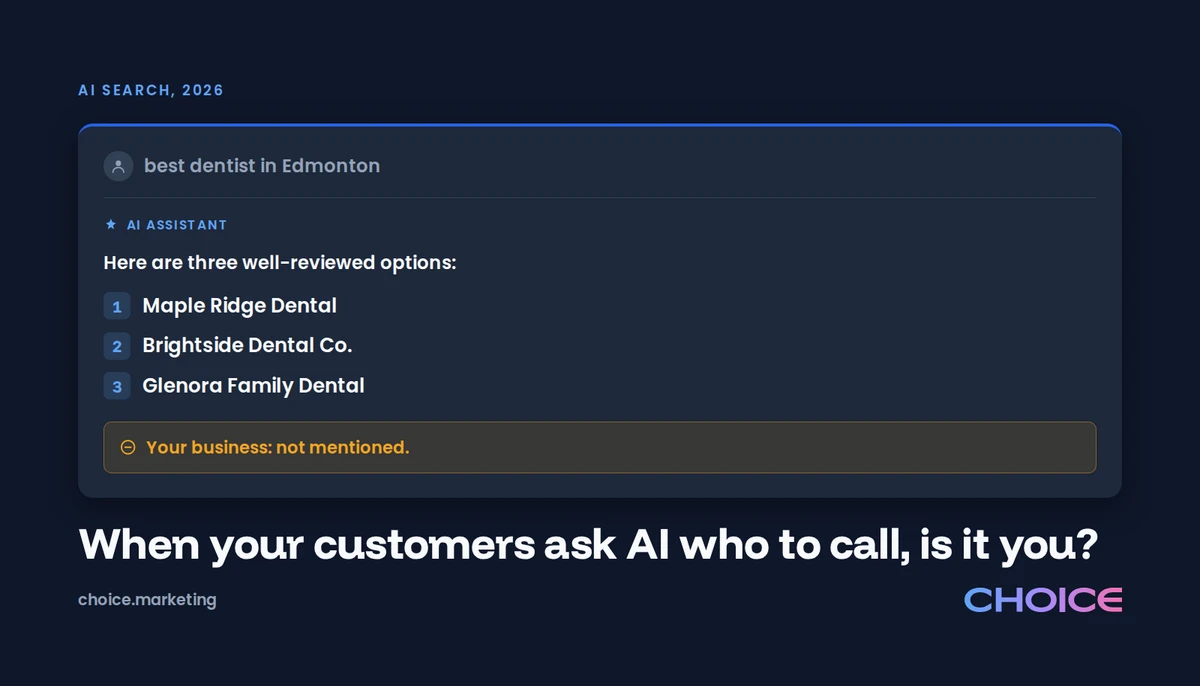
When a customer needs a dentist, a plumber, or a parts supplier, more of them now ask an AI assistant, and it answers the question and names one business to call. For most local companies, that business is a competitor. Across the 28 client websites we track, we improved average Google position from 37 to 13 and earned 19% more impressions over the past year while clicks stayed flat, because the answer is now read on the results page. In the same month, AI bots read our clients' sites more than 85,000 times and sent 346 visits back. The businesses AI recommends are the ones with strong reviews, a complete Google Business Profile, and clear website content a machine can quote.
Most owners have never seen the answer AI gives about them, and their analytics will never warn them about it. The traffic looks normal, the rankings look fine, and a competitor is quietly being named to the customer before they ever reach a website. This post shows the mechanism, with our own client data, and what to do about it.
For the version of this happening fastest in one industry, see AI Overviews are eating healthcare search traffic. For the paid-media side of the same shift, see our field guide to ChatGPT Ads in 2026 and how we track visibility across AI platforms.
The 30-second test
Open ChatGPT, Google's AI Overview, or Perplexity right now and ask it what your customers ask. Try "best [your service] in [your city]" and "who should I hire for [their problem] in [your city]." Read the answer. Notice which businesses it names, and whether yours is one of them.
That answer is the new shelf your customers see first. Most owners have never once looked at it. Everything below explains what you just saw.
Why did AI name a competitor instead of you?
AI does not pick a name at random; it reads the open web and recommends the business that looks most credible. It weighs your reviews, your ratings, your Google Business Profile, the directories you appear on, and the words on your own website.
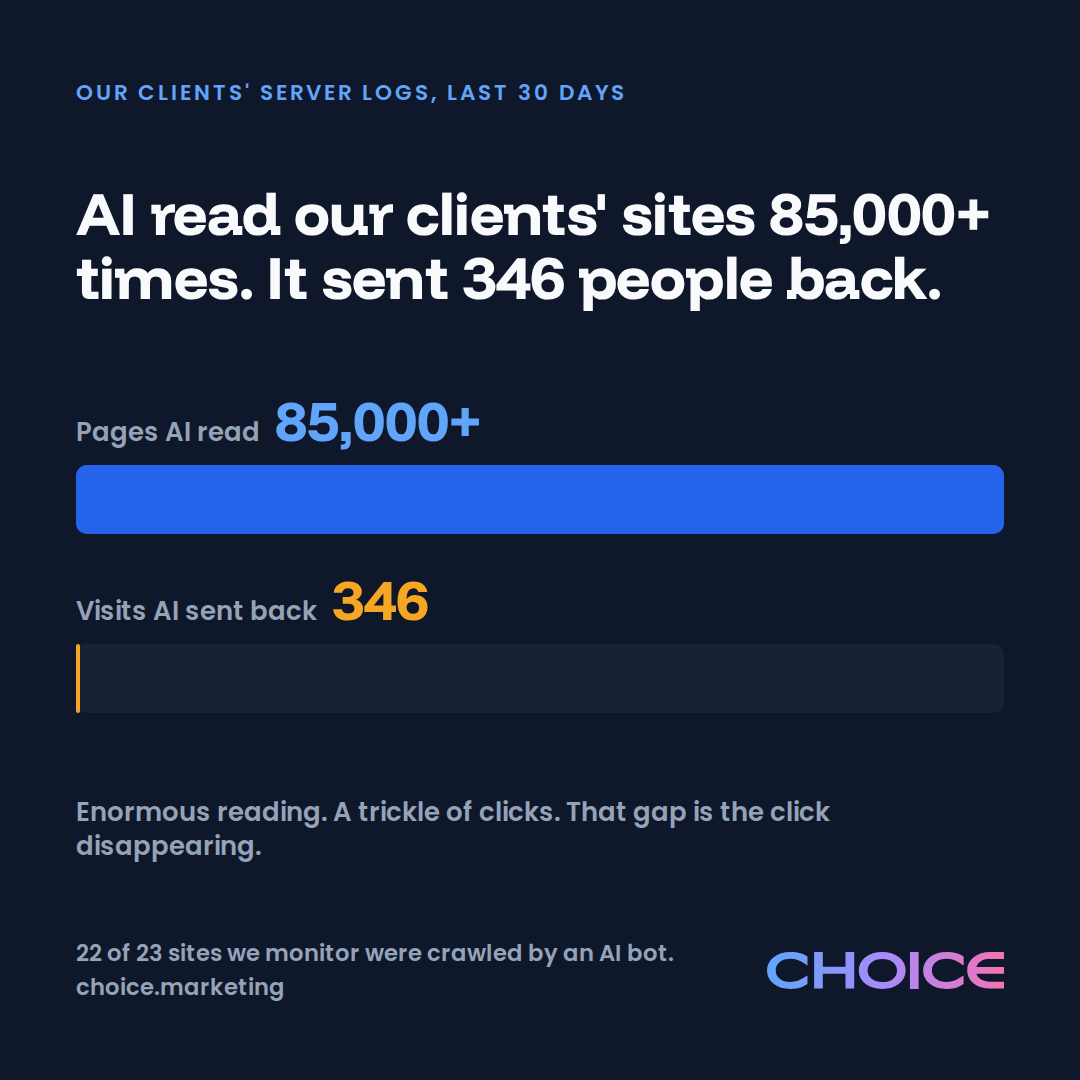
We can prove it is already doing the reading. In the last 30 days, AI crawlers from OpenAI, Anthropic, Perplexity, and Google made more than 85,000 requests to read our clients' websites, and 22 of the 23 sites we monitor were visited by at least one. Some of those were not background training runs; ChatGPT, Claude, and Perplexity each fetch a live page the moment a customer's question calls for it. AI has already studied your business. The only open question is what it concluded.
It also explains why you might appear in one assistant and vanish in another. They lean on different amounts of evidence: ChatGPT cites a handful of sources per answer, around seven; Perplexity pulls from far more, around sixteen; Google's AI Overviews sit in between. And no single assistant owns the market. ChatGPT still leads, but it recently slipped below half of all assistant users for the first time as Google's Gemini gained ground, so betting your visibility on one tool is a real risk.
Why doesn't your website report show it?
Your analytics say AI sends you almost no traffic, and that is exactly the problem: when you look at where your visits come from, AI barely registers, which feels like reassurance but is actually the opposite.
AI shows up as near-zero in your reports because it answers in place and keeps the visit for itself. Our own numbers make the gap plain: in the same month those AI systems made more than 85,000 requests to read our clients' pages, they sent back 346 visits. Enormous reading, a trickle of referrals: AI is using your business to answer the question without ever sending the person over.
Independent research shows the same pattern. Pew Research Center found that when an AI summary appears on a Google result, people click a traditional link 8% of the time, against 15% when there is no summary, and they click the links inside the summary just 1% of the time. The answer satisfies the question, and the visit never happens.
It is even harder to see than that. Many of the few visits AI does send arrive with no referrer attached, so analytics tools file them under "Direct," mixed in with people who typed your address from memory. The influence is real, and your dashboard is blind to it.
Can you rank #1 on Google and still lose the customer?
Yes, and it is happening now. Ranking at the top of Google is no longer the same as being found; our own book of business is the proof.
| Metric (28 client sites) | Mar to May 2025 | Mar to May 2026 | Change |
|---|---|---|---|
| Average Google position | 37 | 13 | ranked higher |
| Impressions | 4.80M | 5.71M | up 19% |
| Clicks | 72,200 | 75,300 | flat |
| Click-through rate | 1.50% | 1.32% | down |
We lifted our clients' average position from roughly 37 to 13 and earned them 19% more impressions, the number of times Google placed them in front of a searcher. Their total clicks barely moved. We made them higher-ranked and more visible, and the clicks did not follow, because the answer is increasingly read on the results page before anyone reaches the links.
For some clients the split was stark. One Canadian firm we manage climbed from the fifth page of Google onto the first and was shown to 31% more people; it received about three thousand fewer clicks than the year before. An Alberta eye-care clinic was shown to 45% more searchers and clicked by 16% fewer of them.
The independent numbers match ours. An Ahrefs study of 300,000 keywords found the top-ranked page loses 58% of its clicks when an AI Overview sits above it. BrightEdge tracked AI Overview coverage of healthcare searches climbing from 59% in 2023 to 89% in 2025, with rankings holding steady while traffic falls. The position you pay to defend is still worth holding. It just no longer pays out the way it used to.
Is search dead?
No. Your customers have not abandoned Google; the finish line just moved earlier. People still search. What changed is where the decision gets made, and more of it now happens before the click: inside the AI answer, in the map pack, in the reviews, in a video someone watched on the way.
The Reuters Institute Digital News Report 2026 found Google sent 38% fewer organic visits to a large set of content sites between late 2024 and late 2025, even as people kept searching. Reuters calls the wider move toward social and video "a drift, not a shift," which is the honest read: not a stampede off the web, but a steady rerouting of where attention and decisions land. For younger customers especially, the journey often starts in a feed or an assistant rather than a search bar. People do not hand AI blind trust either; they trust its answers far less than established sources and use it to narrow the field, then check. Which means your real job is to be the name that survives the narrowing.
What does AI check before it recommends a business?
The businesses AI recommends are the ones that look most trustworthy to a machine reading the open web, and most of what it checks, you control. The answer layer reads five things before it names anyone:
- Your reviews. Volume, rating, and how recent they are. This is the strongest signal in local recommendation, for the machine and the human alike.
- Your Google Business Profile. Complete and accurate categories, services, hours, photos, and answered questions. This is still where "near me" gets settled.
- Your website content. Clear, specific answers about what you do, where, and for whom, structured so a machine can read and quote them. Vague homepages do not get cited.
- Your consistency across the web. The same name, address, and phone number everywhere, and mentions on the directories and sources the models already trust.
- Your presence where journeys start. Showing up in feeds and short video for the customers who begin there, not only in the search results.
None of this is rented. Unlike ad targeting, which the big platforms are automating and quietly taking out of your hands, these are signals you own and improve. That is the good news buried inside the threat: the work that wins the AI answer is the same work that has always earned trust, and it compounds over time.
Didn't third-party cookies go away?
No, the cookie apocalypse got called off, and your measurement still got harder. Google planned to strip third-party cookies from Chrome, reversed course in 2024, and through 2025 effectively shelved the plan, so those cookies are still in place: the scare was real, but the deadline never arrived.
Tracking did get less reliable anyway, from iOS privacy controls, consent rules, and ad blockers. So the move that actually matters is not bracing for a deadline that keeps slipping. It is owning your first-party data, the customers and contacts that are yours no matter what a browser does, and keeping your tracking clean. Ignore the panic headlines; fix the fundamentals.
See what AI says about your business
Go back and look at what AI said about you. If your name was in the answer, good; protect it. If a competitor's was there instead, that is fixable, and finding out exactly what AI is saying about your business costs nothing.
We run your business through the ten AI platforms that matter and send you a short, plain-language report: where you show up, where a competitor shows up instead, and the single change that moves the needle fastest. No cost, and no sales pitch in the report itself. The diagnosis is free. The call, if you want one, is for the plan. Get your free AI check.