
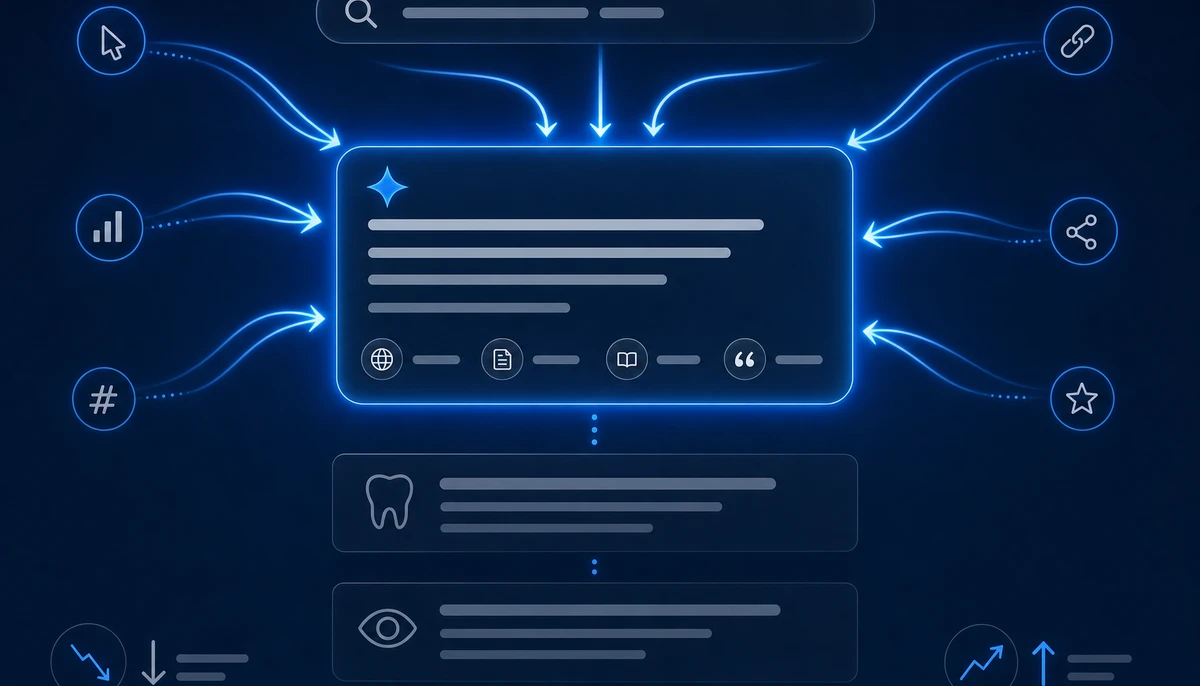
Clicks to choice.marketing fell 70% over the past 28 days. In the same window, impressions rose to more than 25,000 and our average Google position improved from 19 to 14. No rankings were lost and no penalty was applied. That pattern is consistent with AI Overviews answering the question on the results page so fewer people click, and the independent data below backs it up. The same shape is showing up on dental and optometry practice sites right now. This post shows the numbers from three sites, explains what changed, and gives you a 90-day citation plan you can run this quarter.
Most practice owners are about to misdiagnose this. They will see clicks fall, assume their rankings dropped or their agency stopped working, and ask for more blog posts. The rankings did not drop. The click did. Those are different problems with opposite fixes, and getting the diagnosis wrong wastes a quarter.
For the broader picture of how AI answer surfaces are reshaping discovery, see our field guide to ChatGPT Ads in 2026 and how we track visibility across AI platforms. This piece is about the one happening fastest to healthcare: Google's AI Overviews.
The data: three sites, same shape
We publish our own numbers because the drop is the story, not a failure. Below is choice.marketing's Google Search Console data for the 28 days ending May 26, 2026, against the prior 28 days. Alongside it are two US dental practices we manage, shown as percentage change only.
| Site | Clicks | Impressions | Average position |
|---|---|---|---|
| Our own site (absolute) | 271 → 81 (down 70%) | 8,812 → 25,229 (up 186%) | 19.2 → 13.6 (improved) |
| US family dental practice | flat (no net change) | up 39% | page 2, stable |
| Second US dental practice | down 6% | up 22% | page 2, stable |
Read our own row carefully. Impressions nearly tripled, the average ranking position got better, and the click-through rate collapsed from 3.08% to 0.32%. Better rankings, far more visibility, fewer clicks. A ranking loss does not produce that combination, and it is consistent with an AI Overview intercepting the answer on the results page. It is one site, so we do not rest the case on it; the independent data below is what carries it.
The first dental practice is the cleanest example of the same mechanism on a much larger site. Its impressions rose 39% in a month and produced zero additional clicks. One of its service pages, an emergency-dentistry page that ranks on the second page of Google, saw impressions rise 170% while its click-through rate fell to roughly a third of what it was. The page did not move in the rankings. The answer simply started appearing on the results page.
Your own site is very likely showing this shape already. Most owners have not pulled the comparison because the top-line traffic number in their analytics looks "down" and they stop there.
Our three sites are not an anomaly. Independent studies find the same pattern across the web. Pew Research Center, analyzing real Google users in 2025, found that when an AI summary appears people click a traditional result in just 8% of visits, versus 15% when there is none, and they click a link inside the summary itself only 1% of the time. Ahrefs, measuring 300,000 keywords against Search Console data, found the presence of an AI Overview correlates with a 58% lower click-through rate for the number-one result. BrightEdge, tracking healthcare specifically, said it plainly: a Position 1 ranking no longer delivers the traffic it did, and practices seeing organic declines while rankings hold steady are almost always looking at AI Overviews.
Why healthcare gets hit harder than other verticals
Three structural reasons, and they compound.
Health queries are disproportionately informational, and informational is what triggers an Overview. Ahrefs, analyzing 146 million search results in 2025, found that 99.9% of the keywords that trigger an AI Overview are informational, and that health and medical queries trigger one 43% and 44% of the time, more than double the roughly 21% baseline across all queries. "Do dental implants hurt," "how long do dental implants last," "how often should I get an eye exam," "is dry eye permanent." These are exactly the questions AI Overviews are built to answer in a paragraph. A query like "emergency dentist near me" still drives a click; a query like "is a cracked tooth an emergency" now gets answered in-pane.
The patient journey starts weeks early, with questions. Someone weighing a $4,000 implant or booking a $200 eye exam usually runs a series of informational searches over days or weeks before they ever search for a provider. Practices used to earn blog and service-page traffic from those early questions. AI Overviews now catch the patient upstream, before they reach your site.
Medical content sits under a higher confidence bar. Google's systems treat health topics as Your Money or Your Life content and lean on recognized medical-authority sources (Mayo Clinic, the ADA, the AAO) for the primary answer. Individual practice pages are more often used as a supporting citation than as the headline source. That means the realistic goal for most practices is to be one of the cited links, not to outrank Mayo Clinic.
What actually changed: citation, not ranking
The mental model has to shift from "did we rank" to "did we get cited."
Rankings did not change. Impressions are still counted, and positions can even improve, because AI Overviews pull their sources from the top of the results and those source links receive a position attribution. What changed is the click. The AI answer now sits above the ten blue links, with three to five inline citation pills. Many searchers read the answer and leave.
A page cited in an AI Overview with no click is not worthless. It still drives downstream branded search ("Smiles on 5th reviews"), direct visits, and recommendations inside ChatGPT and Perplexity, which pull from overlapping source pools. The new value of a page is whether it earns the citation, and whether your brand is the one named next to it.
The shift in one line: stop optimizing for rank-then-click, and start optimizing to be cited, or to be the brand the searcher remembers after reading the citation.
The playbook: five citation-targeting moves
These are the five moves that move the needle this quarter. None of them is "write more blog posts."
They map onto what research on AI-cited health sources actually rewards. A 2026 study of the sources cited in AI health answers grouped the signals into four domains: author credentials, institutional affiliation, quality vetting, and digital discoverability. The moves below operationalize those for a practice website.
1. Add the schema that makes your pages machine-readable
Structured data does not buy you a citation, but it gives Google's extraction layer clean, confident context to pull from. For practices, the high-value types are FAQPage, MedicalBusiness (or its Dentist subtype), Physician, MedicalProcedure, and MedicalCondition.
A minimal FAQPage block for a dental question, placed on the relevant page:
<script type="application/ld+json">
{
  "@context": "https://schema.org",
  "@type": "FAQPage",
  "mainEntity": [{
    "@type": "Question",
    "name": "How long do dental implants last?",
    "acceptedAnswer": {
      "@type": "Answer",
      "text": "With good oral hygiene and regular checkups, dental implants commonly last 20 years or more. The crown attached to the implant may need replacement after 10 to 15 years."
    }
  }]
}
</script>
The same shape extends to the practice itself with a Dentist or MedicalBusiness block (name, medicalSpecialty, address, telephone, priceRange) and a Physician block for each named doctor. Test every block in Google's Rich Results Test before it ships. Broken schema is worse than none.
2. Put extractable numbers on the page
A page built around specific, liftable figures is easier for an answer engine to quote than three paragraphs of adjectives: "a single implant typically costs $3,000 to $5,000," "adults should have an eye exam every one to two years." Add a short "by the numbers" block to each key service or procedure page, and attach a clear source to every figure. Treat this as a format-and-accuracy move rather than a guaranteed citation trick: it makes your page quotable and keeps your own claims defensible.
3. Attach credentials to your answers
Author credentials are one of the four authority signals that study identified in AI-cited health sources, and most practices waste them. "Dr. Jane Smith, DDS, explains:" carries more authority than the identical text in anonymous body copy. Use a visible byline, a credential string, and Person schema. Practice owners who are themselves the treating doctor are sitting on this signal for free and usually not using it.
4. Earn third-party mentions
A practice mentioned in local news, an industry publication, or a vertical podcast accumulates an entity graph that Google's scoring layer uses to disambiguate and trust your brand. One targeted effort per quarter is enough: a local-news angle, a professional-association feature, or a guest spot on a relevant podcast. This is the slowest lever and the hardest for a competitor to copy.
5. Write in the formats that get extracted
Question-and-answer pages, comparison tables (implant vs. bridge vs. denture; LASIK vs. PRK), step-by-step procedure explainers, and "what to expect on the day" walkthroughs all match the shape AI Overviews prefer to extract. Long, meandering essays do not. If you build one new content asset this quarter, make it a comparison table or a procedure Q&A, not a 1,500-word think piece.
What not to do
- Do not write more generic blog posts on "5 benefits of dental implants." That market is saturated, the Overview answers it inline, and the page will earn impressions with no clicks.
- Do not gut your existing pages. Pages that still earn impressions are still building entity authority even when clicks are down. Deleting them removes citation candidates.
- Do not chase Overviews with thin, AI-generated filler. Google's helpful-content systems penalize it, and citation correlates with the same quality signals that helpful-content rewards.
- Do not judge success on Search Console clicks alone in 2026. That number will keep falling for informational health pages whether you do the right thing or the wrong thing.
- Do not bolt on stethoscope stock photos to look "more medical." Trust signals here are real authors, real credentials, and real third-party mentions, not visual set dressing.
What it looks like when the fix works
A Canadian multi-location optometry group we manage rebuilt its website this spring on exactly these foundations: clean LocalBusiness and Optometrist schema on every location page, structured FAQ content, and an llms.txt file that tells AI crawlers what the practice is and where it operates. The groundwork was in place the day the new site went live.
Within the first week, the practice's branded queries improved from an average position of 8.0 to 4.4, and its neighbourhood "eye care" searches moved onto page one: one climbed from position 6.2 to 1.4, another from 9.2 to 2.6. Branded click-through rose 44%. Organic traffic had not had time to compound yet, so the early lift shows up exactly where it should first: in position, and in being the named brand, which is the leading indicator for AI citation and the branded search that follows it.
One honest caveat: that is a single week of data immediately after launch, so treat the figures as an early read, not a settled trend. The direction is the one the playbook predicts.
The 90-day plan: optometrist version
| Weeks | Focus |
|---|---|
| 1 to 2 | Pull Search Console, compare clicks vs. impressions on the top 20 pages, and flag the high-impression, low-CTR pages (the Overview casualties). Confirm MedicalBusiness and Physician schema is present. |
| 3 to 6 | Add FAQPage schema to the top five service pages (eye exams, dry eye, contact lenses, pediatric, myopia control). Embed one credentialed doctor quote and one "by the numbers" stat on each. |
| 7 to 10 | Publish two Q&A pages targeting unsaturated questions ("how often should an adult get an eye exam," "what is myopia control"). Internally link them from existing content. |
| 11 to 13 | Run one digital-PR push (a school-vision-screening seasonal angle, or a statistic from your own anonymized patient data). Submit to one professional publication. |
For the broader local-search foundation underneath this, see our work on optometry practice marketing.
The 90-day plan: implant dentist version
| Weeks | Focus |
|---|---|
| 1 to 2 | Same audit. Expect the heaviest Overview impact on "do dental implants hurt," "how long do dental implants last," and "all-on-4 cost." |
| 3 to 6 | Schema work: MedicalBusiness plus Physician, MedicalProcedure for each implant procedure, and FAQPage. Embed a doctor video with a written transcript (transcripts are extractable; video alone is not). |
| 7 to 10 | Build one comparison-table asset (implant vs. bridge vs. denture, or all-on-4 vs. all-on-6) and one financing explainer ("what it costs in monthly payments at 0% for 24 months"). Both are extractable formats. |
| 11 to 13 | One digital-PR push (regional edentulism statistics, or an existing community give-back). Get the doctor on one industry podcast. |
We have run this for implant practices; one example is in our dental implant campaign results, and the vertical foundation is on our dental marketing page.
How to measure whether it is working
Stop watching the click number alone and track these signals instead.
| Signal | Where to find it | Why it matters |
|---|---|---|
| Citation presence | Manual or scripted checks of which queries surface you in an AI Overview; commercial trackers also exist | The leading indicator of whether the work is landing |
| Branded search lift | Search Console, filtered to queries containing your practice name | Overviews drive branded search even when the citation click is missing |
| Direct and organic visits to /contact and /book | Analytics | Bottom-of-funnel pages do not get Overview-eaten, because "Smith Dental booking" is not an informational query |
| Phone volume by "found us on Google" | Call tracking | Overviews often route to a Google Business Profile click rather than a website click |
There is a sharper version of citation tracking that almost nobody does, and it is the one that matters. Being named in the answer text and being cited as a source link are two different signals, and they do not always travel together: a page can be cited without the practice being named, named without earning the link, or both. We pull AI Overviews and Perplexity results for our own market and track those as two separate columns, because the gap between them tells you whether you are building entity authority (being named, which a patient remembers and later types as a branded search) or just supplying raw material (being linked, which the patient never sees). We have watched one competitor get named in the answer text of three different Overviews while rivals were only linked. Aim to be the named brand.
What to ignore: total session count (it will look bad), bounce rate (meaningless when traffic skews to higher-intent visitors), and average position (an improving number that no longer predicts clicks).
Frequently asked questions
Are AI Overviews hurting dental and optometry websites specifically? Yes, and harder than most verticals, because health searches are disproportionately informational and AI Overviews answer informational questions in-pane. The measurable signature is impressions rising or holding while clicks and click-through rate fall, with no loss in ranking position.
My rankings are fine but my traffic dropped. What happened? That is the AI Overview pattern. Your page is still ranking and is likely being used as a source, but the answer now appears above the links, so fewer people click. The fix is citation targeting, not chasing rankings you already have.
How do I get cited in an AI Overview?
Give the extraction layer clean material to pull: structured data (FAQPage, MedicalBusiness, Physician), credentialed authorship, third-party mentions, quotable figures, and Q&A or comparison-table formats. Research on AI-cited health sources points to author credentials, institutional authority, quality vetting, and discoverability as the distinguishing signals. There is no paid placement and no guarantee.
Should I delete pages that lost clicks? No. Pages that still earn impressions are building entity authority and are citation candidates. Deleting them removes you from the answer pool.
Does this also affect ChatGPT and Perplexity? Yes, though not identically. A 2026 analysis found the three surfaces cite very differently: ChatGPT cites about 7 sources per answer and leans on each heavily, while Google AI Overviews and Perplexity cite roughly 12 and 16 and spread the weight thin. They are not interchangeable, but the underlying work (authority, structured content, being a trusted source) pays across all three. We cover measuring them in tracking visibility across AI platforms.
What is the honest shelf life of this advice? The specific behavior of AI Overviews will keep shifting, and this playbook will need a refresh within a year. The foundations (schema, credentialed answers, extractable formats, third-party mentions) are stable. The principle outlasts the specifics: be cited, or be the brand named after the citation.
The bottom line
AI Overviews are the search game in healthcare now. Clicks to informational pages will keep falling whether a practice acts or not, so the click number is no longer the scoreboard. Citation is. Practices that get schema, credentialed answers, extractable formats, and third-party mentions in place this quarter will compound an advantage; practices that wait will watch the gap to their faster competitors widen, and that gap is hardest to close once a rival's entity authority is established.
The diagnosis is simple, and most owners are getting it wrong: this is not a ranking problem you fix with more blog posts. It is a citation problem you fix with the playbook above.
If you want a straight read on whether your practice site is losing clicks to AI Overviews, which pages are affected, and exactly what schema and content changes would put you in the answer, we offer a no-obligation audit. You get a written findings document on what is working, what is not, and what would move the number.
For related reading, see our ChatGPT Ads field guide, how the Google Ads job changed in 2026, scaling multi-location healthcare marketing, and our work on SEO and AI marketing.