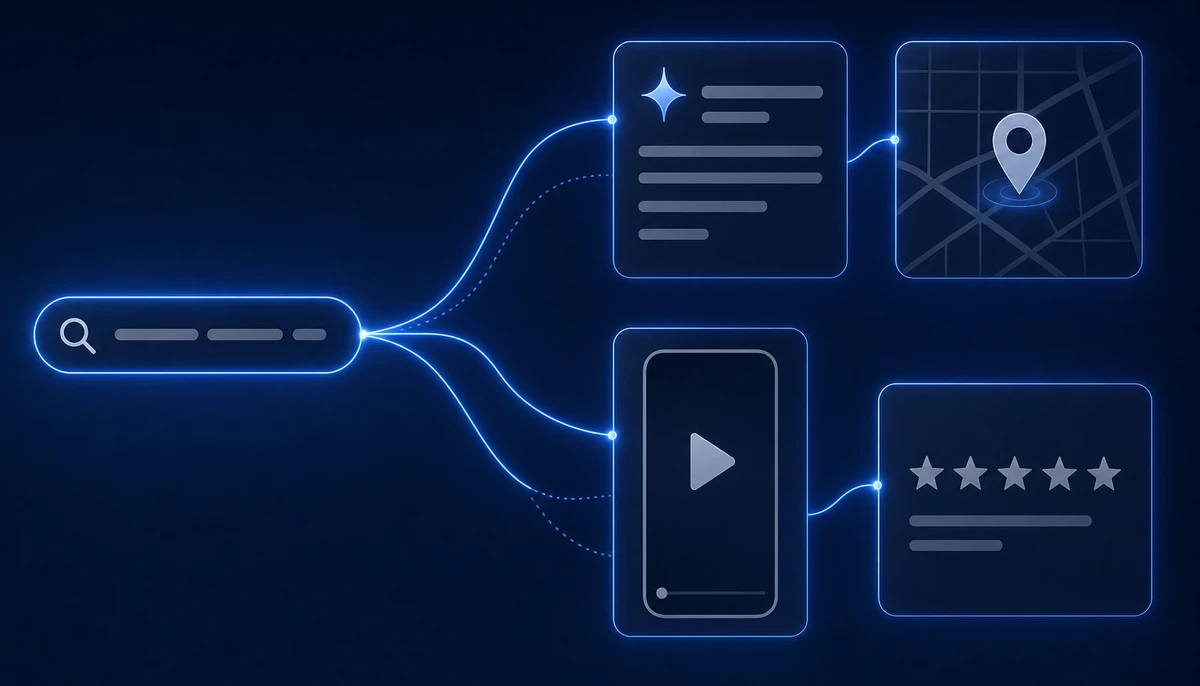
The click-first model of digital marketing is breaking, but search is not dead. AI assistants, AI Overviews, social video, and Google Business Profiles increasingly resolve a buying decision before a customer ever reaches your website. The winning move for SMBs is to widen the definition of visibility: be present in search, maps, reviews, social discovery, and AI answers, not only in blue links.
For the last 20 years, most digital marketing strategy has been built around a simple assumption:
People search.
They click.
They land on your website.
Then they convert.
That model still holds some truth, but it no longer covers the whole picture.
AI, social video, Google Business Profiles, map packs, reviews, automated ad systems, and zero-click search are changing where people spend their time and how they make decisions online.
The most important shift is not that everyone suddenly stopped using Google.
They have not.
The more important shift is that more of the decision now happens before a person ever reaches your website.
That is the change businesses need to understand.
I work with small and medium-sized businesses that still get real leads from Google every day, so I do not buy the lazy claim that "search is dead."
But I do think the click-first model is breaking.
The misleading statistic: AI sends very little referral traffic
One of the easiest mistakes to make right now is to look at referral traffic and conclude that AI is not very important.
On paper, Google still dominates measured web referrals. AI assistants send a tiny share of traffic compared with traditional search. If you only look at analytics dashboards, AI can look like a rounding error.
That interpretation is dangerous.
Referral traffic only measures visits that happen after someone clicks.
AI assistants are designed to answer questions inside the interface. Google AI Overviews are designed to answer directly on the results page. Social platforms are designed to keep users inside the feed. Maps and review platforms often resolve local intent without requiring a website visit at all.
So when AI sends very little referral traffic, that does not prove AI is irrelevant.
It may prove the opposite.
It means AI can influence the decision without sending the click.
That is the real strategic issue for businesses.
The click is disappearing before the customer disappears
The Reuters Institute Digital News Report 2026 gives us a useful lens for understanding this shift.
Globally, social and video platforms have now become the most-used way people access online news. Reuters Institute data reported that 54% of respondents accessed news through social and video platforms, ahead of TV at 52% and news websites or apps at 51%.
That does not mean every business should become a media company.
But it does show a larger behavioural shift: people are getting more information from platforms that summarize, recommend, rank, curate, or package content before the user ever reaches the original source.
The North American correction matters, though.
The evidence does not support the simplistic claim that AI chatbots are rapidly replacing search for news in the United States or Canada. In mature markets, AI-for-news usage appears more uneven and less explosive than the hype suggests.
The bigger issue is referral collapse.
A Reuters Institute-related 2026 report, covered by The Guardian, found that publishers expect search referrals to fall sharply over the next three years. It also reported that Google search traffic to news sites had already dropped by about a third globally, with the U.S. hit even harder.
That pattern is not limited to journalism.
It is a preview of what can happen across the broader web.
For small and medium-sized businesses, the same behaviour is spreading into commercial research:
- "What is the best physiotherapist near me?"
- "Which dealership has the best reviews?"
- "What should I look for before hiring a roofing company?"
- "Who sells industrial equipment in Alberta?"
- "Which local business is most trusted for this service?"
Historically, those questions led to search results, website visits, phone calls, and form fills.
Increasingly, they may lead to an AI summary, a map pack, a Reddit thread, a YouTube video, a TikTok recommendation, a Google Business Profile, or a chatbot-generated shortlist.
The business can still win the customer.
But it may not win the website visit first.
Search still matters, but it is no longer just "search"
Google is still central to local and commercial discovery. That is not going away.
But Google itself is changing.
Search results are becoming more answer-heavy, more visual, more automated, more personalized, and more blended with AI.
Google AI Overviews and AI Mode are part of that shift. Instead of only giving users links, Google increasingly gives users synthesized answers, comparisons, summaries, and next-step suggestions.
Recent academic research on Google AI Overviews shows why this matters. A 2026 paper, "Measuring Google AI Overviews: Activation, Source Quality, Claim Fidelity, and Publisher Impact", found that AI Overviews appeared for 13.7% of trending queries overall, but rose to 64.7% for question-form queries. Another 2026 study, "How Generative AI Disrupts Search", found AI Overviews for 51.5% of representative real-user queries in its dataset.
Those numbers differ because the query sets and methodologies differ.
That is the point.
There is no single universal "AI Overview trigger rate." The rate depends heavily on the type of query, the topic, the market, the wording, and the measurement method.
For businesses, the exact percentage matters less than the direction: AI-generated answers are becoming a normal part of the search experience.
That changes the job of SEO.
Classic SEO asked:
Can we rank?
Modern search strategy asks:
Can we rank?
Can we be cited?
Can we appear in the map pack?
Can we show up in AI-generated answers?
Can we be trusted by review systems?
Can our content be understood by machines?
Can our brand be recognized before the click?
Can our ads appear in AI-powered search surfaces?
That is a much bigger job than writing blog posts and chasing keywords.
The rise of answer visibility
I think the next major marketing discipline for SMBs will be answer visibility.
Answer visibility means your business shows up when platforms generate, summarize, recommend, or shortlist options.
That includes:
- Google AI Overviews
- Google AI Mode
- ChatGPT
- Gemini
- Claude
- Perplexity
- Copilot
- Google Business Profile
- Google Maps
- Reddit threads
- YouTube results
- TikTok search
- Instagram recommendations
- Review platforms
- Industry directories
- Local citations
- Structured website content
The old question was:
"Do we rank on Google?"
The new question is:
"When a person or AI system asks who should be trusted, are we part of the answer?"
That is the strategic shift.
ChatGPT is still leading, but the AI assistant market is fragmenting
Another correction matters.
A year ago, it was easier to talk about "ChatGPT" as shorthand for consumer AI. That is becoming less accurate.
Recent Sensor Tower data, reported by TechRadar, said ChatGPT's share of the global AI assistant market fell below 50% for the first time in May 2026. The same report placed ChatGPT at 46.4%, Gemini at 27.7%, and Claude at 10.3%.
I would not build strategy around those exact decimals.
These numbers move monthly, and every tracker measures the market differently.
The more important point is that the assistant market is fragmenting.
ChatGPT remains the largest assistant, but Gemini has the advantage of Google's ecosystem: Search, Android, Chrome, Workspace, and default distribution. Claude, Perplexity, Copilot, Grok, DeepSeek, and Meta AI are all competing for different kinds of usage.
For business owners, the takeaway is simple:
Do not optimize for one chatbot.
Optimize for the systems that AI tools commonly depend on:
- Clear website structure
- Consistent business information
- Strong reviews
- Authoritative third-party mentions
- Useful service pages
- Local relevance
- Schema markup
- Accurate location data
- Original expertise
- Fresh content
- Trust signals
AI assistants are not magic.
They draw from the web, search indexes, business listings, reviews, directories, media, forums, structured data, and platform partnerships.
If your business is unclear, inconsistent, thin, outdated, or invisible across those sources, AI systems have less reason to recommend you.
Local businesses still need Google Business Profile more than almost anything else
For local SMBs, Google Business Profile remains one of the most important assets on the internet.
That is especially true for healthcare practices, automotive services, home services, restaurants, professional services, and location-based businesses.
When people search locally, they often do not want a website first.
They want:
Who is nearby?
Who is open?
Who has good reviews?
Who looks legitimate?
Who offers the service I need?
Who can I call now?
Who has photos?
Who has recent activity?
Who has the right category?
Who looks trustworthy?
Your website matters, but your Google Business Profile may be the first conversion surface.
That means local strategy needs to include:
- Accurate categories
- Complete services
- Strong photos
- Review generation
- Review responses
- Fresh posts and updates
- Correct hours
- Location consistency
- Q&A management
- Appointment links
- Call tracking
- UTM tracking
- Local landing pages
- Structured data
- Citation cleanup
The businesses that treat Google Business Profile as a living conversion asset will outperform those that treat it as a directory listing.
Social video is becoming a search behaviour
Younger consumers increasingly use TikTok, Instagram, YouTube, and Reddit as discovery engines.
This does not mean every business needs to dance on TikTok.
It means people want proof before they trust a business.
They want to see:
- Real work
- Real people
- Real explanations
- Before-and-after examples
- Customer stories
- Walkthroughs
- Pricing context
- Common mistakes
- Behind-the-scenes credibility
- Short answers to specific buying questions
For many SMBs, social content should not be treated as entertainment.
It should be treated as searchable proof.
A dental clinic can explain treatment options.
A mechanic can show common vehicle issues.
A physiotherapist can explain injury recovery.
A wrap shop can show installs and material differences.
An industrial supplier can explain product selection.
A B2B equipment company can show use cases.
This content can influence buyers even when it does not generate a clean last-click conversion.
That is why attribution is getting harder.
The customer may see a video, check reviews, ask ChatGPT, search the brand, look at the map listing, and then call.
If you only measure the final click, you miss the journey.
Paid advertising is becoming more automated and less transparent
The other major shift is happening inside ad platforms.
Google and Meta are pushing advertisers toward more automation: Performance Max, AI Max for Search, Advantage+, broad match, automated creative, automated placements, and automated bidding.
There is upside here.
Small businesses can benefit from machine learning systems that find patterns faster than a human media buyer can. Automated campaigns can improve efficiency when conversion tracking is clean and creative inputs are strong.
But there is risk.
Automation can also hide where money is going, blur the difference between brand and non-brand demand, generate weak creative, expand into poor-fit queries, and make reporting harder to explain.
This is especially important for regulated healthcare, niche B2B, industrial, legal, financial, and high-trust services.
The future of ad management is not "let the machine do everything."
It is:
Give the machine better inputs.
Set stronger guardrails.
Track better conversion data.
Review search terms and placements.
Separate brand demand from new demand.
Control creative quality.
Understand where automation helps and where it hides waste.
AI will not eliminate advertising strategy.
It will punish weak strategy faster.
The website is still important, but its role is changing
Some people hear "zero-click" and assume websites are becoming irrelevant.
That is wrong.
The website is still the source of truth. It is still where your expertise, services, locations, offers, case studies, pricing context, team, proof, and conversion paths live.
But it no longer functions only as a destination.
It is also a data source for:
- Search engines
- AI assistants
- Ad platforms
- Review systems
- Knowledge panels
- Local listings
- Social previews
- Retargeting audiences
- Sales teams
- Customers doing due diligence
A modern SMB website needs to be built for humans and machines.
That means:
- Clear service pages
- Strong internal linking
- Schema markup
- Fast loading
- Mobile usability
- Crawlable content
- Helpful FAQs
- Real expertise
- Local relevance
- Trust signals
- Clear calls to action
Thin websites will struggle.
Generic AI-written content will struggle.
Businesses that explain what they do clearly, specifically, and credibly will have an advantage.
What SMBs should do now
The following six steps turn this into action.
1. Protect your local foundation
Your Google Business Profile, reviews, maps visibility, citations, service pages, and location pages need to be accurate and active.
For local businesses, this is still one of the highest-impact areas.
2. Build content that answers real buying questions
Not generic blog content.
Not keyword-stuffed filler.
Not "10 reasons to hire a professional" articles that say nothing.
Useful explanations that help customers make decisions.
3. Track more than website sessions
Website traffic may decline even while influence increases.
Track:
- Calls
- Forms
- Map actions
- Branded search
- Review activity
- Assisted conversions
- CRM outcomes
- AI referral sources
- Google Business Profile actions
- Paid and organic lead quality
4. Test your AI visibility
Ask ChatGPT, Gemini, Perplexity, Claude, and Google what they recommend for your service in your market.
See whether your business appears.
See who is cited.
See what information is wrong or missing.
This is not perfect research, but it is a useful diagnostic.
If AI systems cannot understand who you are, where you operate, what you offer, and why you are credible, that is a marketing problem.
5. Strengthen your trust signals
Reviews, case studies, testimonials, credentials, author bios, location signals, third-party mentions, and clear business information all matter more in an AI-mediated web.
Trust is not one signal.
It is the accumulated evidence that your business is real, relevant, and worth recommending.
6. Use ad automation carefully
Performance Max, AI Max, broad match, and Advantage+ can help, but only when conversion tracking, creative, landing pages, and account structure are strong.
Automation does not fix weak fundamentals.
It amplifies them.
The real takeaway
AI is not replacing the internet.
It is changing the route people take through it.
People still search.
People still visit websites.
People still compare options.
People still read reviews.
People still watch videos.
People still ask friends.
People still click ads.
People still call businesses.
But the journey is more fragmented and automated, increasingly mediated by platforms before the business ever sees the visitor.
For SMBs, the winning strategy is not to abandon SEO, websites, or ads.
The winning strategy is to expand the definition of visibility.
You need to be visible in search.
Visible in maps.
Visible in reviews.
Visible in social discovery.
Visible in AI answers.
Visible in paid placements.
Visible in the places customers now make decisions.
The click has not disappeared.
But it can no longer be assumed.
And the businesses that understand that first will have the advantage.
Sources and further reading
- Reuters Institute Digital News Report 2026
- The Guardian: Publishers fear AI search summaries and chatbots mean "end of traffic era"
- MarketWatch: Most people now get their news from social media
- TechRadar: ChatGPT market share falls below 50% for first time
- Measuring Google AI Overviews: Activation, Source Quality, Claim Fidelity, and Publisher Impact
- How Generative AI Disrupts Search: An Empirical Study of Google Search, Gemini, and AI Overviews
- Google Search Central: Google Search spam policies
- Google Ads Help: About Performance Max campaigns