
ChatGPT Ads are worth a small test this season for Canadian retailers who sell online and track purchases. The minimum budget is $25 CAD a day. Launch by mid-November for Black Friday, or by early December for Boxing Day. Before launch, work out what you can afford to pay for one sale. That number decides whether the test worked.
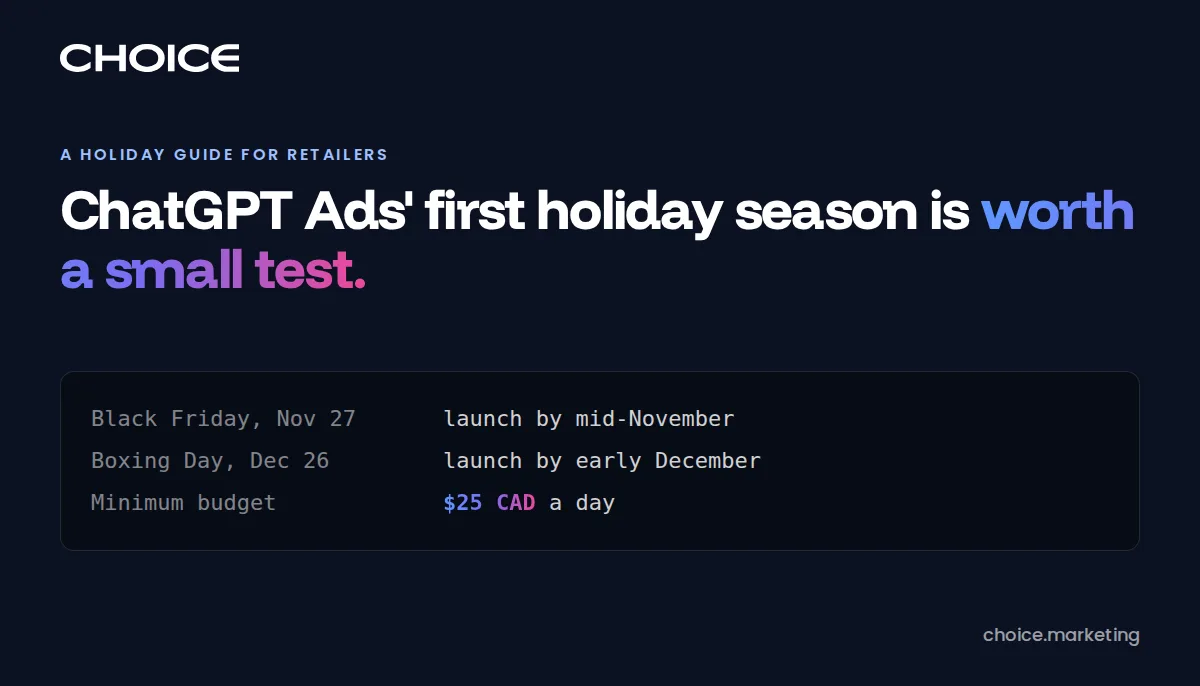
This post helps you decide whether a test fits your store. It also shows what we saw when we set one up, and how to judge your results.
ChatGPT Ads launched this year, so this is their first holiday season, by OpenAI's count. Businesses based in Canada can buy them in OpenAI's self-serve Ads Manager, from $25 CAD a day.
We think it's worth a try. That view rests on our intuition and on how we, our friends, and our families are making purchase decisions. The state of Google points the same way.
Intuition only goes so far, so we want data. Running ChatGPT Ads this holiday season? When the season wraps up, send us your results and tell us what worked and what didn't.
Who should try it this season
ChatGPT Ads suit retailers that sell online and can track purchases. The steps below build a campaign around purchases on your website, so you need a store that takes orders online. Skip it or wait in these cases:
- Your business isn't based in an available country. Canada is on OpenAI's list, and the business that advertises and pays must be based in an available country.
- You sell in a closed category. OpenAI's ad policies generally prohibit health services ads outside the US. Legal services ads are US-only, and most financial categories are restricted. Read the ad policies first, since some product categories have their own rules.
- You can't track online purchases yet. The campaign optimizes toward purchases, so it needs purchase data. If tracking won't be ready by mid-November, aim for Boxing Day instead.
- No one can check results every few days. A holiday campaign needs attention through December.
Start small and keep Google running
ChatGPT sends websites far fewer visits than Google, so test it on a small budget. Ahrefs tracks 118,671 websites. In October 2026, Google sent 24.74% of their visits, and ChatGPT sent 0.36%. Similarweb found that 95% of ChatGPT users also use Google.
Visits only count clicks. Many shoppers compare options inside ChatGPT and decide there, so we think a visit count understates its influence. Ads Manager can also credit a sale made within a day of someone seeing your ad. No click is needed. Google will still carry most of your holiday traffic, so keep it running. Fund ChatGPT from a separate test budget.
A test can be small. The minimum daily budget is $25 CAD per campaign, so 30 days at the minimum comes to $750 CAD. The daily budget is an average over seven days, so a single day can spend up to $50 CAD. Set a budget you'd be comfortable spending with no sales.
What we learned setting one up
We've run ChatGPT Ads once, and this month we set up a second test. In June, we ran three campaigns for Choice OMG's own agency services. They earned 8,940 impressions and 58 clicks, and not one lead. ChatGPT only shows ads to people on its Free and Go plans. The business owners we wanted were more likely to pay for ChatGPT, so many never saw the ads. Our ChatGPT Ads field guide has the full numbers. We think that limit matters less for consumer products than it did for us.
In November, we set up a pilot for Choice Graphics, the vehicle graphics shop Choice OMG owns in Edmonton. It sells a fixed-price commercial decal package through a quote form. A quote request stands in for a purchase, so the campaign optimizes toward OpenAI's Lead created event. The steps match a store's, and the screens taught us a few things.
Only standard events can be a campaign's goal. Our older custom event, generate_lead, was greyed out in the campaign form. Send your sales as OpenAI's standard Order created event, or a conversion campaign can't use them.
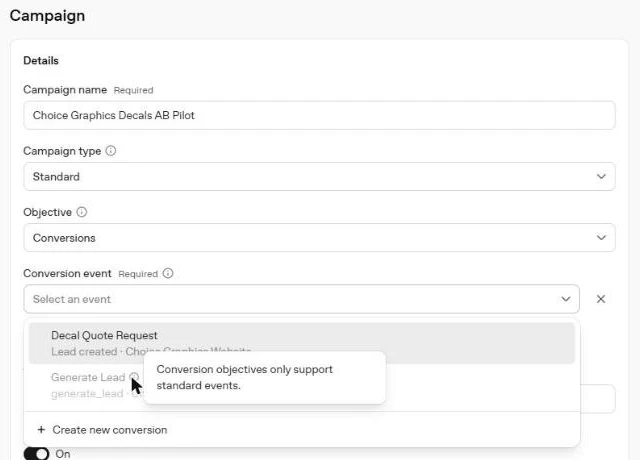
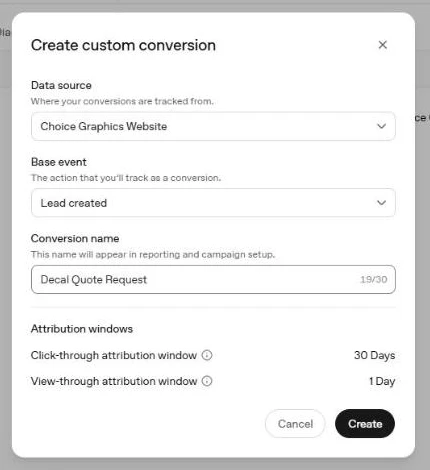
The conversion setup decides how long a sale can count. The defaults were 30 days after a click and 1 day after a view. Ads Manager uses these windows to optimize. You set the windows for your reports separately.
Our Conversions campaign was billed by impressions. The form offered no per-click option for that objective. It also added tracking parameters, utm_source=chatgpt_ads, so your store analytics can spot ChatGPT visits. Creative enhancement was switched on by default.
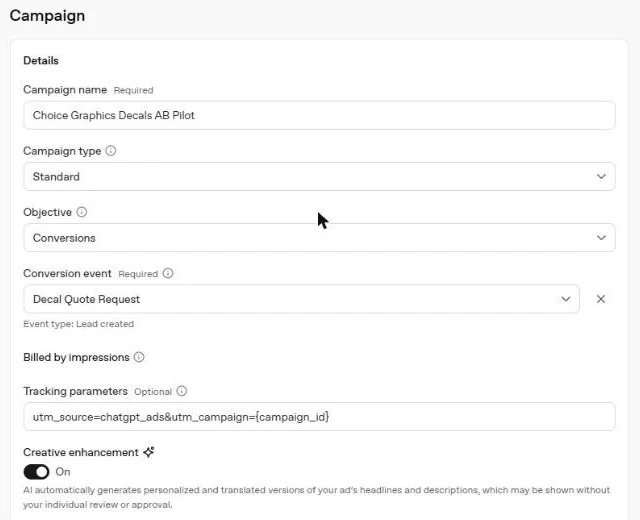
Creative enhancement can change your ads without asking. OpenAI's settings say it can write new headlines and descriptions, resize images, adjust landing page links, and translate ads. Those versions may run without your review. Decide before launch whether your brand can live with that.
Canada targets by province or postal code. We couldn't pick a city. For Edmonton, we could choose Alberta, or postal code prefixes such as T5A and T5J.
Ads show your account's brand name. Our first ad preview said Choice OMG on a decal ad, so we changed the brand name. Saving that change sends the account into review, and ads don't serve until it clears.
Check the Event Stream before you spend. We sent a test quote from our staging site and watched it arrive in Ads Manager within a minute. Then we found a trap in Google Tag Manager. Sometimes a tag reads an event ID that isn't there. Then it gets the text "undefined." Our first tag sent that as a real lead. Make your purchase tag check that the ID exists before it fires.

How to set up ChatGPT Ads for the holidays
Set up tracking and your catalogue first, then launch early and check often. These steps follow OpenAI's official holiday guide and help centre. The guide walks advertisers through getting ChatGPT Ads ready for the season. Our notes add Canadian context and what we saw when we set one up.
- Let OpenAI's crawlers in. OpenAI requires its ads crawler, OAI-AdsBot, to review your landing pages. Allow it in robots.txt and in any firewall or bot protection. If you run a product feed, also let OAI-SearchBot reach your product image links, or the feed can fail. Our three AI crawler questions help you check this with your developer.
- Install the OpenAI Pixel and the Conversions API. OpenAI recommends using both together. Send matching event IDs through each, so purchases aren't counted twice. Include the order value with each purchase. Ads Manager's sales and return on ad spend columns only count purchases that carry an amount. Confirm in the Event Stream that purchases arrive.
- Check your event quality score. Ads Manager scores the quality of your conversion data and flags problems. Fix the warnings before your big promotions. The score refreshes daily over seven days, so fixes show up gradually. OpenAI says the score doesn't predict campaign performance, so treat it as a check on your tracking.
- Upload your product catalogue. Do it early, so you have time to fix feed problems. Keep prices, promotions, and stock levels current as your offers change. Product feed ads are in beta, so check that your account has them. On Shopify, the ChatGPT Ads for Shopify app syncs your catalogue and creates campaigns from Shopify.
- Build the campaign around purchases. Choose the Conversions objective and the Order created event as its goal. You pay for impressions, never per conversion. Use automated bidding unless you have a reason to set targets.
- Plan for the November 9 bidding change. OpenAI told advertisers that new conversion campaigns will use Target CPA (target cost per action) in place of Max Bid from November 9, Search Engine Roundtable reported. Max Bid retires on January 1, 2027. If you set targets, build holiday campaigns on the new option.
- Write context hints and seasonal ads. Context hints tell the system who a product is for and the need it meets. "Insulated boots for someone who walks to work in winter" says more than "holiday gifts." Build separate ads around seasonal products, holiday offers, and shipping deadlines.
- Launch two to three weeks before your first big shopping day. OpenAI says that gives the system time to learn before demand peaks. Black Friday falls on November 27 this year, so a Black Friday push should launch by mid-November. If your tracking won't be ready by then, aim for Boxing Day and launch by early December.
- Check results every two to three days. Look at delivery, purchases, and cost per purchase each time. Purchases can take 24 to 48 hours to appear, and spend lags by about seven to eight hours. Move budget gradually toward the campaigns that beat your goals, and give each change time to work.
- Keep going after Christmas. People keep shopping into the new year, and in Canada, Boxing Day falls right in that stretch. Have Boxing Day and early January offers ready. Then use the season's results to decide where to keep spending.
How to judge your test
Work out what one sale is worth before you launch. Start with your average order value and multiply it by your gross margin. Then subtract average shipping and what returns cost you. What's left is the most you can pay for one sale and still break even.
Example: what one sale is worth
| Average order | $80 |
| Kept at a 40% gross margin | $32 |
| Less average shipping | $8 |
| Less the cost of returns | $4 |
| Most you can pay for one sale | $20 |
For illustration. Use your own store's numbers.
Count sales after a click and after a view separately. With the view window set to one day, Ads Manager's Conversions total includes view-through sales. Those are sales made within a day of an ad view, without a click. Add the Click-through conversions and View-through conversions columns to see each part. Some of those view-through shoppers would have bought anyway, so we'd give them less weight. Judge your cost per sale on click-through sales first.
A $750 test may not give you a clear answer. At $20 a sale, $750 buys about 37 sales at break-even. A few sales either way can change the verdict. So check your own store data too. Look for orders tagged utm_source=chatgpt_ads, and compare your holiday weeks with last year's.
Then decide whether to stop, keep going, or spend more. We'd give a test 30 days at $25 CAD a day before deciding.
- Stop if each click-through sale costs well above your break-even and your store shows no lift.
- Keep going if they cost about your break-even, and keep checking every few days.
- Spend more, in small steps, if they cost less than your break-even.
Why we think it's worth a test
Google is under pressure, and its share of search is overstated. On October 29, Alphabet had its worst day on the stock market since Google went public in 2004. Its shares fell nearly 13%, wiping out roughly $500 billion in market value. Search advertising revenue grew 12% to $63.35 billion, below analysts' expectations, CNBC reported.
BNP Paribas analyst Nick Jones wrote that the results likely revived fears of ChatGPT and other rivals eroding Google search. Search wasn't the only worry: Alphabet also reported negative free cash flow of $9.07 billion for the quarter.
The usual share figure counts search engines only. StatCounter had Google at 85.04% of search in Canada in October 2026, down from 87.65% a year earlier. ChatGPT isn't on StatCounter's list, so that figure overstates Google's position. OpenAI says ChatGPT now handles about one fifth as many search-like queries as Google. That figure is self-reported, and Ahrefs estimated about 12% in February using a stricter count.
Canadians are moving too. Leger's 2026 AI Index found that 18% of Canadians say they turn to AI first when searching for information online. That group has tripled since Leger started tracking it in 2024.
Shoppers already use ChatGPT to decide
Shoppers already ask ChatGPT what to buy. OpenAI says retail and ecommerce conversations account for more than 1.7 billion prompts a week. About 43% of shopping-related conversations involve comparing and evaluating options.
The holidays push those numbers up. OpenAI says US product-search activity in ChatGPT rose 52% during the 2025 holiday season, and 94% on Black Friday. Adobe forecasts that AI traffic to US retail sites will grow 130% this holiday season. These figures are US data, and we haven't found Canadian equivalents.
Run ChatGPT beside Google on a small budget this season. By January, you'll have your own numbers on whether your customers buy through ChatGPT. We'd like to hear them. Our ChatGPT Ads explainer covers how the format works if you want more background first.
References
Adobe. (2026, September 28). Adobe: U.S. holiday shopping season to hit record $275.1 billion online, rising 6.7% YoY [Press release]. Business Wire. https://www.businesswire.com/news/home/20260928285775/en/
Ahrefs. (2026). AI vs search traffic analysis. Retrieved November 5, 2026, from https://ahrefs.com/benchmarks/ai-vs-search
CNBC. (2026, October 29). Alphabet tanks nearly 13% for worst day ever, losing $500 billion in value. https://www.cnbc.com/2026/10/29/alphabet-google-microsoft-msft-shares-today-earnings.html
Ji, C. (2026, October 29). Why Alphabet's stock is on track for its worst day ever after the latest results. MarketWatch. https://www.morningstar.com/news/marketwatch/20261029182/why-alphabets-stock-is-on-track-for-its-worst-day-ever-after-the-latest-results
Kantrowitz, A. (2026, November 3). OpenAI: ChatGPT search is about 20% of Google's, 250 million people speak with ChatGPT, and Chat is merging with Work. Big Technology. https://www.bigtechnology.com/p/openai-chatgpt-search-is-about-20
Leger. (2026). Key trends from Leger's 2026 AI Index. https://leger360.com/ai-usage-in-canada-2026-ai-index/
OpenAI. (n.d.-a). Ad policies. https://openai.com/policies/ad-policies
OpenAI. (n.d.-b). Ads Manager availability. OpenAI Help Center. https://help.openai.com/en/articles/20001245-ads-manager-availability
OpenAI. (n.d.-c). Advertiser guidance for allowing OpenAI web crawlers. OpenAI Help Center. https://help.openai.com/en/articles/20001243
OpenAI. (n.d.-d). Create campaigns from product feeds. OpenAI Help Center. https://help.openai.com/en/articles/20001268-create-campaigns-from-product-feeds
OpenAI. (n.d.-e). Creating campaigns for ChatGPT Ads. OpenAI Help Center. https://help.openai.com/en/articles/20001210-create-campaigns-for-chatgpt-ads
OpenAI. (n.d.-f). Measure results. OpenAI Help Center. https://help.openai.com/en/articles/20001214-measure-results
OpenAI. (n.d.-g). Understanding and improving event quality. OpenAI Help Center. https://help.openai.com/en/articles/20001513-understanding-and-improving-event-quality
OpenAI. (2026a). ChatGPT Ads holiday best practices 2026 [PDF]. https://go.openai.com/rs/504-SWE-347/images/ChatGPT%20Ads%20Holiday%20Best%20Practices%202026.pdf
OpenAI. (2026b). Reach holiday shoppers in ChatGPT. https://ads.openai.com/holiday
Search Engine Roundtable. (2026, November 5). OpenAI updates ChatGPT Ads bidding options for max bid or max CPC. https://www.seroundtable.com/openai-updates-chatgpt-ads-bidding-options-42470.html
Similarweb. (2026). Is AI replacing search? What the 2026 numbers actually reveal. https://aisearch.similarweb.com/blog/is-ai-replacing-search/
StatCounter. (2026). Search engine market share Canada. Retrieved November 5, 2026, from https://gs.statcounter.com/search-engine-market-share/all/canada
Stox, P. (2026, February 11). ChatGPT has 12% of Google's search volume but Google sends 190x more traffic to websites. Ahrefs. https://ahrefs.com/blog/chatgpt-has-12-percent-of-googles-search-volume/