
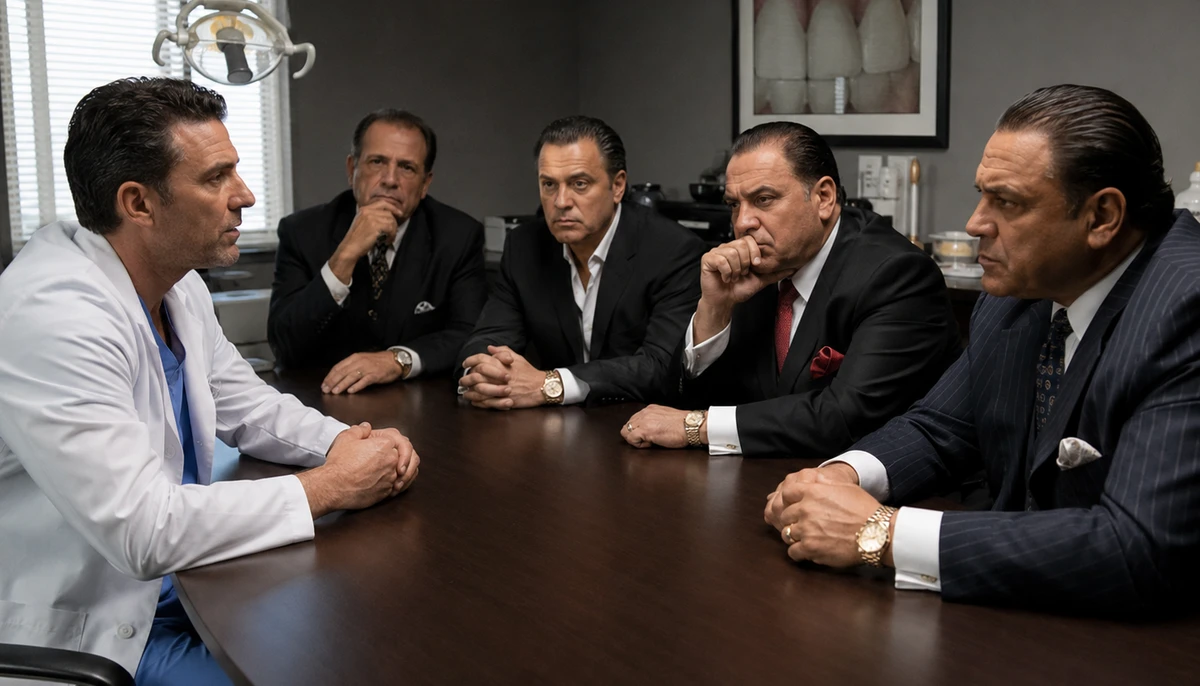
Dr. Clark Damon's Texas dental implant practice joined Frontline DIS across late 2023 and early 2024. From the front of the funnel I watched the same operational stack the major PE-backed DSOs install go in around me. The operational model is the actual asset: the equity transfer is mostly the packaging around it, and the two are separable.
Dr. Clark Damon's Texas dental implant practice joined Frontline Dental Implant Specialists across late 2023 and early 2024. Frontline brands itself as a "Dental Implant Partnership Network," not a buyer; its parent, Leon Capital Group, explicitly says it is "not a private equity fund." My seat was the front of the funnel. I built the call tracking, the conversion attribution, and the marketing ROI reporting that fed everything downstream. From there I saw the same operational stack the major PE-backed DSOs roll out get installed around me. A Salesforce instance. Qualification tiers. Financing-first scripts. End-to-end click-to-patient tracking. It worked. Revenue compounded on the cases that mattered most. Two years and a stack of public PE research later, I am certain that most dentists evaluating a similar offer, whether from a PE-backed DSO or a family-office-backed partnership network, should run the operational version without the equity transfer. The model is what installs revenue compounding. The equity structure around it is mostly the packaging. This post is part one. It covers what that operational model actually is, what gets installed, where the revenue actually comes from, and what life looks like for the selling dentist on the other side of the deal. Part two ships the independent-friendly alternative.
Two things this post is not. It is not financial deal advice. The math of multiples, earn-outs, rollover equity, and holdback provisions belongs in a conversation with a dental-specific M&A advisor; this article addresses the operational and marketing questions that determine whether the financial math even makes sense. It is also not an argument that selling is always wrong. Succession-driven exits, founder burnout, and geographically isolated practices that cannot scale on their own are legitimate sell scenarios where a DSO partnership is the right answer. The audience for this post is the owner who has been approached, weighed an LOI, watched a peer sell, and wants to understand the operational model before deciding.
The setup
Frontline reports 14+ practices, 3 states, and 4,695+ annual implant procedures across its network. Whether the Damon transaction was structured as a traditional acquisition, a recapitalization, or a partnership equity rollover, the operational integration that followed was the same playbook a PE-backed DSO would have run. The practice was a high-volume implant operation with a substantial full-arch case mix. I was the marketing analytics contractor sitting between the practice and the platform that absorbed it. My work predated the close by months and continued through the integration phase, which is how I ended up watching the operational stack get installed in real time.
What I built
I did not build the Salesforce side. I built the tracking layer that fed it, the front of the funnel, across three concrete integrations.
First, the call tracking layer. I deployed a hybrid setup: CallRail for the standard campaign-to-call attribution, plus custom Twilio tracking numbers I had built for the channels where the off-the-shelf coverage was insufficient. Together they captured every inbound consultation request, attached the campaign source, tagged the call recording, and fed the result into the downstream Salesforce instance the platform was installing. The integration covered Google Ads, Meta, SEO landing pages, and the practice's referral lines. Every ringing phone produced an attributable data row.
Second, the conversion attribution methodology. I designed a custom weighted attribution model focused on consultations completed. Performance Max was still in its early stages at Google Ads, and the data picture was being assembled in real time; there were not yet enough fully-attributed revenue markers to weight on closed cases, so consultation completion became the primary success signal the model optimized around. The model credited campaigns across the multi-touch consultation journey. Implant cases close on weeks, not minutes; a first-touch model misattributes the eventual case to the wrong campaign, and a last-touch model misattributes it to whatever happened to be running on the day the patient called. The methodology gave the platform real visibility into which channels drove qualified full-arch consults, not just which channels filled the top of the funnel.
Third, the marketing ROI reporting. I built the dashboards that translated all of that into language the platform's operators could act on: cost per qualified consultation by channel, cost per case acceptance by channel, and marketing-attributable revenue (monthly and trailing-twelve). The dashboards lived in Google Sheets and fed the Salesforce instance through webhook posts so the operational stack downstream could close the loop on every campaign.
The specificity matters because it is the credentialing layer of this post. I was not watching the integration happen from across the room. I was inside the integration, building the part that fed everything else.
What I watched get installed around me
The full operational stack went in over the months that followed the close.
A Salesforce instance for the practice's lead-to-case pipeline. The build included custom objects for consultation type, case classification, and financing-approval status. The instance was administered centrally by the platform, not by the practice. Reports rolled up to platform leadership.
Qualification tiers. The funnel got formal stages: inbound lead, qualified lead, consultation booked, consultation attended, treatment plan presented, financing approved, case accepted, case completed. Each stage had ownership, an SLA, and a conversion target. The tiers existed before the acquisition in rough form; the platform formalized them and tied them to compensation downstream.
A treatment-coordinator script structure built around the financing conversation. The coordinator would surface options (CareCredit, in-house plans, third-party medical lending) early in the consultation rather than late. The script existed to convert cases that would otherwise stall on patient hesitation about cost, and it worked.
Production scheduling logic. The chair-time templates got optimized for high-margin procedures. Full-arch days got blocked together. Hygiene capacity got compressed. The dentist still held the clinical decisions; the schedule that shaped the patient mix shifted under platform control.
End-to-end click-to-patient tracking. The tracking layer I built fed Salesforce, which fed the platform's reporting layer, which fed the regional operations team's KPIs. By the time the stack was fully installed, every patient was a tracked row from the first ad impression to the final case completion.
I watched all of this from the front-of-funnel vantage point.
Table: the PE operational stack installed at the practice
| Component | What it does | Who controls it post-close |
|---|---|---|
| Salesforce CRM instance | Centralizes lead-to-case data, custom objects, reporting | Platform |
| Qualification tier structure | Formalizes funnel stages, attaches SLAs and targets | Platform |
| Treatment-coordinator script | Financing-first consultation flow | Platform (design and updates) |
| Production scheduling logic | Optimizes chair-time for high-margin procedures | Platform template, dentist clinical calls |
| Call tracking and attribution | Campaign-to-case credit, all channels | Platform |
| Centralized purchasing | Lab, supplies, software | Platform |
| Review management | GBP, public response policy | Platform |
| Marketing budget allocation | Channel mix, geo, creative cadence | Platform |
Why it worked: the operational compounding
The operational stack compounded revenue on the cases that mattered most, and the cost side compressed at the same time.
Heartland Dental publishes the numbers itself. Heartland-supported offices spend 2.9% of revenue on supplies versus an 8.7% industry average. Doctors completing Heartland's Doctor Leader Track program average 39% higher production. Those numbers are Heartland's own marketing language; they are not a critic's framing. They illustrate the order of magnitude of the operational compounding the dental PE model is built to capture.
The broader healthcare PE evidence pairs cleanly. Borsa and colleagues published a systematic review in BMJ in July 2023 on private equity ownership across healthcare settings. The review found PE ownership is associated with higher costs and a mixed-to-harmful effect on quality. The cost-and-revenue compounding is consistent across the healthcare PE literature, not specific to dentistry.
The implant-specific connection runs through TAG, the holding company also known as The Aspen Group. TAG acquired ClearChoice in 2020. ClearChoice is the largest implant-focused DSO in the United States, with roughly 80 centers nationally. The same operational management entity that owns Aspen Dental also runs the country's largest implant-specific brand. The PE-dental playbook is being applied directly inside implant practices at national scale.
The surgical-specialty rollup is active in parallel. U.S. Oral Surgery Management (USOSM) now operates in 28 states with more than 250 oral and maxillofacial surgeons, expanded through successive credit facilities since its November 2021 recapitalization with Oak Hill Capital. The pattern that absorbed Aspen and Heartland and ClearChoice is now absorbing oral-surgery practices that place implants.
Where the revenue actually came from
After private equity acquisition, dental offices shifted their service mix from preventive care toward restorative, specialty, and surgical procedures, increased submitted charges by 3.3%, and did not obtain higher insurer reimbursement, meaning the revenue lift came from patients, not payers.
That sentence summarizes the most important piece of public research published on dental PE to date. Nasseh et al. published "Financial Incisors" in Health Services Research in December 2025. The study ran a difference-in-differences design on dental office data from 2015 to 2021. The findings, in order of operational importance:
Service mix shifted from diagnostic and preventive procedures toward restorative, specialty, and surgical procedures. Submitted charges per office rose 3.3% (95% CI 2.3% to 4.4%). Practices were more likely to become multispecialty over the period. Negotiated insurance prices did not change. The increase in revenue came from charging more for more-intensive services to the same patients, not from extracting better terms from payers.
The companion Health Affairs paper by Nasseh, LoSasso, and Vujicic, published in August 2024, established the underlying scale of dental PE growth. Together with Borsa, the three peer-reviewed sources triangulate: PE-dental ownership has grown materially, costs and revenue compound on the operational side, and the post-acquisition revenue lift in dentistry specifically comes from service-mix shift and charge increases borne by patients.
Service mix is the quieter mover
Service mix is the bigger lever and the less-discussed half of the Nasseh finding. The Nasseh data is industry-wide PE-dental, not implant-specific; the implant case is the most visible instantiation of the broader pattern.
For an implant-focused practice, the post-acquisition service-mix shift looks like more full-arch consultations, more financing-friendly case planning, fewer routine hygiene-only visits in the marketing funnel, and treatment coordinators trained to surface higher-acuity options earlier in the conversation. This is operationally legitimate from a margin perspective. Full-arch cases produce more revenue per chair-hour than hygiene visits, and the operational stack is built to find and convert them.
The question is who designs the conversation and whose incentives sit on the treatment coordinator's script. When the script is designed by an independent owner-dentist who is clinically present and accountable for outcomes, the financing-first conversation looks one way. When the script is designed by a platform with production quotas and compensation thresholds attached to non-owner clinical staff, it looks different.
The financing-first conversation, decoded
Financing-first is the script structure that converts a $30K full-arch case into an accepted treatment plan instead of "I'll think about it."
The coordinator surfaces financing options early. CareCredit is the most common third-party medical-credit partner; in-house financing and Proceed Finance round out the typical stack. The financing question moves up the consultation timeline so the patient hears "you can afford this" before the patient hears "let me think about it." The presumptive close is built into the script structure.
This is not inherently bad. Financing-first scripts work, and they make access to large cases possible for patients who would otherwise walk. The thing to watch is who designs the script and whose compensation is tied to its outputs. The California Attorney General's 2026 settlement with Aspen specifically restricted non-owner clinical staff from being compensated on product or sales-driven incentives, including a hygienist incentive structure that paid $50 to $100 per clear-aligner sale. That restriction is in the public record because the AG found the prior compensation structure problematic enough to require an injunction.
Post-close operational reality from the dentist's seat
The selling dentist's day changes in specific ways after acquisition, and most of those changes are not in the LOI.
Production quotas frequently get applied to the dentist personally. The California 2026 Aspen settlement enjoined non-owner-clinician production incentives specifically, which indicates how common the structure was. Treatment-coordinator reporting lines move from the dentist to a regional operations manager. Scheduling control moves to a centralized template that optimizes for production efficiency rather than for the dentist's clinical pace preference. Lab and supply selection authority centralizes to platform purchasing, which is where the 2.9% versus 8.7% Heartland supply-cost number comes from; it is also where the dentist loses material-quality choice.
Associate compensation structures typically shift toward production-based formulas with platform-set thresholds. Hygienists and other clinical staff who used to defer to the dentist on case planning now operate inside scripts the platform designed.
Not every PE-backed practice runs this hard on every dimension. Heartland and MB2 use marketing language emphasizing doctor autonomy, and that emphasis is genuine at some practices. The regulatory record at Aspen describes the opposite end of the spectrum. Both can be true at different companies and different individual practices. The point is to know what to negotiate against in the management services agreement (MSA) and what to watch for after close.
The marketing-stack diligence checklist
The LOI-reader needs a set of operational questions to ask the platform during diligence. Eight that fall inside the marketing-and-attribution layer where I have standing:
- What attribution methodology do you use to track new-patient sources, and who owns the underlying data?
- How is the treatment-coordinator script designed and updated, and who can change it?
- Are non-owner clinical staff compensated on production or product sales, and at what thresholds?
- What is your production-scheduling logic optimizing for, and can I see the template?
- What is the data-portability provision if I exit? Do I keep the CRM, the attribution history, and the patient communication archive?
- How is marketing budget allocated across locations in your network, and who decides allocation for mine?
- What is your financing-partner stack, and can I negotiate my own preferred relationships?
- What review-management policy applies to my Google Business Profile, and who replies to negative reviews?
For the financial-deal questions (multiples, earn-out structure, holdbacks, non-compete), engage a dental-specific M&A advisor. The questions above are the operational and marketing complement.
The regulatory record
The compensation-structure governance failure is structural, not service-line-specific.
Four state-level and federal actions document the recurring pattern. Each is in the public record; each names the entity, the conduct, and the resolution.
Table: the regulatory record
| Year | Jurisdiction | Entity | Resolution | Conduct findings |
|---|---|---|---|---|
| 2015 | New York AG | Aspen Dental Management (ADMI) | $450K civil penalty + Assurance of Discontinuance | 300+ complaints since 2005; fee-splitting; ADMI taking 45% to 50% of each office's monthly gross profits versus a flat management-fee structure |
| 2018 | DOJ | Benevis (Kool Smiles) | $23.9M settlement | 130+ affiliated pediatric clinics; medically unnecessary Medicaid procedures driven by production targets and cash bonuses |
| 2026 | California AG | Aspen Dental | $2M penalties + $300K restitution + first-in-state injunctive terms | No employee compensation tied to practice sales; no clinical-staff incentives tied to product sales; no non-owner-clinician revenue incentives; documented hygienist incentive of $50 to $100 per clear-aligner sale |
TAG, the holding company behind the Aspen Dental entity in all four AG actions, also owns ClearChoice, the largest implant-focused DSO in the US. The same management approach extends across both brands. The implant practice owner reading this should not assume their service line is somehow insulated. The California 2026 injunctive terms read as service-line-independent guardrails; "no employee compensation tied to practice sales," "no clinical-staff incentives tied to product sales," and "no non-owner-clinician revenue incentives" apply identically to a dentures-and-extractions chain and to a full-arch implant practice.
Canadian sidebar
The Canadian PE-dental story is on the same trajectory as the US, roughly ten years behind, compressed by the CDCP.
GTCR took dentalcorp private in an all-cash deal that closed January 14, 2026, worth C$2.2 billion in equity and C$3.3 billion in enterprise value. Dentalcorp reached 575+ practices and 5.6 million annual patient visits before the deal. The transaction is the most consequential PE-dental event in Canada to date.
123Dentist operates 450+ clinics, 5,000+ clinicians, and 2M+ annual patients after the 2022 Altima/Lapointe merger, backed by Peloton Capital Management, KKR, Heartland Dental, and Sentinel Capital. The platform reported 214% revenue growth from 2021 to 2024 and continued acquiring in late 2025 (MCA Dental Group). Canadian DSO penetration is variously estimated at 17% to 22%; no ADA HPI equivalent dataset exists for Canada, so the figure is softer than the US number.
The Canadian Dental Care Plan is the strategic accelerant. CDCP launched in May 2024, is administered by Sun Life for residents under $90K, and had enrolled nearly 6 million Canadians and 27,000+ providers by late 2025. Health Canada reported a 52% pre-authorization denial rate from November 2024 to June 2025, and roughly 85% of dentists report frequent claim denials. CDCP disproportionately rewards organizations with centralized billing, pre-authorization workflows, and the appetite to accept the program's fee schedule. That is structurally what DSOs are built for.
The regulatory exposure side is less developed in Canada than in the US. Dental regulation is provincial. Alberta's Health Professions Act sections 104 to 115 restrict dental practice to licensed members or professional corporations, with a Responsible Dentist requirement administered by the College of Alberta Dental Surgeons (CADS). Ontario's RCDSO has similar structure. The DSO/MSO architecture being tested in the California 2026 settlement is the same architecture operating in Canadian provinces. No Canadian regulator has publicly tested it at chain scale yet.
The bottom line for Canadian dentist-owners is the same trajectory as the US, compressed by CDCP. Expect Canadian consolidation to keep accelerating.
The thesis
The operational model is the asset. The equity transfer is the packaging. The operational compounding is largely separable for owners who stay operationally engaged.
When a dentist sells to a PE-backed DSO or joins a family-office-backed partnership network, what they are paying for in the lost equity upside is not the chairs, not the brand, not the patient list. It is the operational stack that compounds the existing business. That stack is mostly installable software, training, and process design. It is separable from the equity transfer in principle and, for many practices, in practice.
Frontline DIS is a useful proof point. A self-described non-PE partnership network installs the same operational stack a PE-backed DSO installs. The compounding does not require the PE capital structure; it requires the model. The capital structure is a separate, downstream decision about who captures the value the model produces.
The post does not claim the alternative is free or trivial. It claims the alternative is separable, and that for many implant-focused practice owners, separating it is the better economic decision.
Table: what the equity transfer is buying vs. what is separately installable
| What the equity transfer is buying | Separately installable? |
|---|---|
| Operational compounding (centralized purchasing, supply costs, marketing efficiency) | Yes, with the right tools and partner |
| Click-to-patient attribution stack | Yes; software exists at every price point |
| CRM and qualification tier structure | Yes; HubSpot, GoHighLevel, or PMS-integrated alternatives |
| Treatment-coordinator role design and financing-first conversation | Yes; training and process design |
| Production scheduling logic | Yes; practice management software supports this |
| Doctor production-lift training programs | Yes; clinical CE plus practice-management coaching |
| Cash at close and earn-out structure | No; only equity transfer monetizes future value upfront |
| Recapitalization optionality and strategic exit | No; only equity ownership creates this |
| Removal of operational decision-making from the dentist | No; only sale produces this. Depending on the dentist, this is a feature or a bug |
The most concrete single anchor: the California Attorney General's 2026 settlement enjoined Aspen from paying hygienists $50 to $100 per clear-aligner sale. That compensation pattern is what the operational model installs inside a PE-backed DSO. The same operational compounding, installed inside an independent practice, runs on different incentives. That difference is what "separable" means here.
Part 2 is now live
Part 2: The 2026 Implant Practice Operational Stack ships the install-it-yourself version. The stack a PE-backed DSO needed Salesforce and a regional operations team to deliver is now buildable for one practice with AI in days, owned by the practice, at around $5,000 per month in total software cost with no new headcount required.
FAQ
What does a typical PE-backed DSO actually install at my practice in year one? The full operational stack: a centralized CRM (commonly Salesforce or a dental-specific alternative), conversion attribution tied to call tracking, qualification tiers from lead through case-acceptance, a financing-first treatment-coordinator script, production-scheduling logic optimized for high-margin procedures, and centralized purchasing. The Heartland Dental published figure is 2.9% of revenue on supplies versus an 8.7% industry average; that is roughly the order of magnitude on the operational compounding.
Will I keep clinical autonomy after the acquisition? It depends on the specific management services agreement. The marketing language at every major platform emphasizes doctor autonomy. The regulatory record describes the opposite reality at the platforms that have been investigated. The New York AG found ADMI taking 45% to 50% of monthly gross profits at Aspen offices, and the California AG's 2026 settlement enjoined Aspen from compensating employees based on practice sales or pushing clinical staff to drive revenue. Read the MSA carefully.
What does the post-close treatment-coordinator script actually look like? Financing-first, presumptive close, multi-tier qualification. The coordinator surfaces financing options (CareCredit, in-house, Proceed Finance) early in the consultation, before the case-acceptance conversation. The structure is not inherently bad; it converts $25K to $45K full-arch cases that otherwise stall on "I'll think about it." The question is who designs the script and whose incentives are loaded onto it. The California 2026 injunctive terms specifically restrict non-owner clinical staff from being compensated on product or sales-driven incentives.
How do I evaluate the marketing operational claims a platform makes during LOI diligence? Ask about attribution methodology, data ownership, the data-portability provision if you exit, who designs the treatment-coordinator script, how non-owner clinical staff are compensated, what production-scheduling logic optimizes for, who allocates marketing budget across the network, and what review-management policy applies to your Google Business Profile. For financial-deal mechanics (multiples, earn-out, rollover, holdbacks), engage a dental-specific M&A advisor.
Can I install the operational stack without selling the practice? Yes, and part two of this post covers it in detail. The components (attribution, CRM, qualification tiers, financing-first scripts, treatment-coordinator role design, production scheduling) are mostly software, training, and process design. The right tools exist at every price point, scaled appropriately for a single practice rather than a 750-office network. What you cannot install without the equity transfer is the cash at close, the rollover-equity recapitalization optionality, and the removal of operational decision-making from your daily life.
What is the CDCP angle for Canadian practices? CDCP launched in May 2024, is administered by Sun Life for residents under $90K, and had enrolled nearly 6 million Canadians and 27,000+ providers by late 2025. The 52% pre-authorization denial rate Health Canada reported from November 2024 to June 2025 creates an administrative burden that disproportionately favors organizations with centralized billing and pre-authorization workflows. This is structurally what DSOs are built for. A well-run independent with a competent back office can still handle it; the CDCP makes the DSO operational efficiency proposition more compelling than it was a year ago.
What should I ask my dental M&A advisor that this article does not address? All the financial-deal questions. Practice valuation multiples for implant-heavy practices in your market and case-mix profile. Earn-out structure (length, performance thresholds, clawback conditions). Cash-at-close percentage. Rollover-equity terms and any preferred-return structure. Holdback provisions. Non-compete radius and duration. Post-close governance rights. Tax structure of the transaction. This article covers the operational side; the financial side needs an M&A advisor who specializes in dental and ideally has done implant-practice deals specifically.
Author note
I worked on the marketing analytics layer of Dr. Clark Damon's Texas dental implant practice referenced above. Specifically: I built the call tracking integration, the conversion attribution methodology, and the marketing ROI reporting that fed the broader operational stack. I did not build the Salesforce side. I did not design the financing-first conversation or the treatment-coordinator script. I saw the rest of the PE operational stack get installed around me and observed how it worked because the front of the funnel was what fed everything downstream. The specific platform names and integration details are in the body of the post.
I now run Choice OMG, a Canadian-based dental and healthcare marketing agency founded in 2010 that builds the acquisition-tracking and operational stack for independent dental practices. If the audience for this post acts on the part-two recommendation, my business benefits. That is an explicit conflict of interest. I have disclosed it in the lede, in the FAQ, and I am disclosing it again here. I was paid as a marketing analytics contractor by the Texas practice during the integration window described above; I have not taken any payment, sponsorship, or commercial consideration from any entity involved in this story since.
The thesis stands despite the conflict because the conflict cuts both ways. I could build the same agency relationship with PE-backed DSOs and have access to a much larger market. I have made the deliberate choice to focus on independent practices because the value transfer in PE acquisitions is increasingly one-sided against the selling dentist, and the operational benefits are independently obtainable. The research backs this view; the AG record corroborates it; my first-person experience aligns with it. Where any of those break down, the post says so. Where the data does not support the thesis (the quality-of-care literature is genuinely thin in both directions), I have flagged that limit explicitly rather than overclaiming.